Endorys Matrix
A proposed conformal sensing interface, with contact quality, acoustic coupling and sensor geometry as explicit design requirements.
Concept architecture ENDORYS.
Endorys investigates the measurement conditions needed to characterize tissue response with ultrasound. This library brings together the proposed architecture, application questions and validation priorities.
Pre-prototype research · Selective openness.
Physical and clinical validation remain outstanding.
Proposed conformal sensing with contact, coupling and sensor position documented.
Acoustic response capture with traceable acquisition conditions.
Investigate response estimates with explicit calibration requirements and uncertainty.
The measurement question: how can tissue response be characterized repeatably when contact, sensor geometry and acquisition conditions vary?
The proposed architecture combines a conformal sensing interface, controlled acoustic acquisition and external analysis. Sensor geometry, contact conditions and uncertainty are treated as part of the measurement record.
The Acoustic Reference Test (E001) is the first planned bench study, aimed at establishing a reproducible acoustic baseline. An integrated sensing module would then be evaluated against that reference. Clinical usefulness requires separate investigation.
Read the architecture ↗A proposed conformal sensing interface, with contact quality, acoustic coupling and sensor geometry as explicit design requirements.
Concept architectureSource selection, synchronized response capture and traceable acquisition metadata, to be evaluated against a conventional acoustic reference.
Bench validation plannedSignal analysis and reconstruction research, with explicit calibration requirements and uncertainty. Synthetic examples support inspection of the analysis workflow.
Research software examples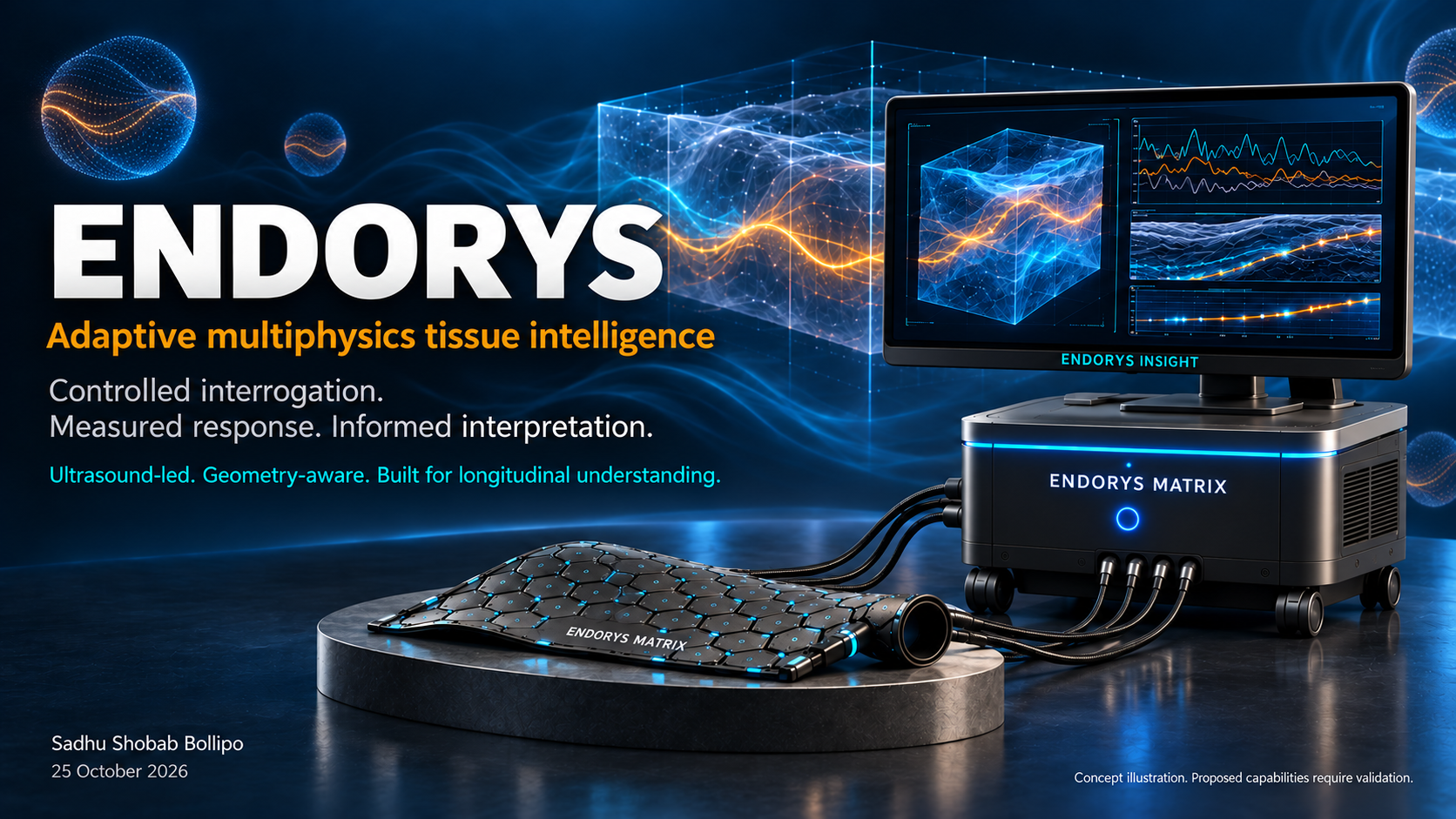
Application candidates inform the research programme. Each requires a defined intended use and separate validation; no clinical indication is established.
Investigate the measurement requirements for repeatable acoustic characterization of tissue response. Breast assessment is the original motivation for Endorys.
The initial experiment uses a non-biological phantom. Human application illustrations describe future research concepts and do not establish clinical performance.
The workstreams organize architecture, applications and validation. They define research scope, not available products or established clinical indications.
Showing all 12 research workstreams.
Each stage requires defined evidence before the programme advances. These milestones are conditional, not launch commitments or completed results.
The Acoustic Reference Test (E001) is planned around a conventional water-path setup and a non-biological sample. It will assess timing, placement and temperature effects on repeatability. Physical results have not yet been established.
Architecture documentation, experimental plans and synthetic analysis examples are available for independent review.
Execute the reviewed protocol and document repeatability, uncertainty, acquisition conditions and unsuccessful runs.
Compare the proposed interface and acquisition architecture with the conventional reference to quantify benefits, limitations and failure conditions.
Define one intended use with clinical input and establish the corresponding performance, quality, risk, usability and regulatory development requirements.
Architecture proposals, synthetic examples and physical measurements provide different levels of evidence. Their status and limitations are stated separately.
Research specifications, literature mapping, experimental planning and contribution guidance.
Explore the repository ↗Synthetic acoustic data and analysis examples support software review. Successful checks do not establish physical or clinical performance.
Run the example ↗The integrated matrix, measured tissue properties, clinical accuracy and treatment outcomes remain to be validated.
Read the research status ↗Sadhu Shobab Bollipo
Founder & independent researcher · Bengaluru, India
Connect with Sadhu ↗Experience in medical-device software, laboratory automation and hardware–software integration informs the focus on system integration, measurement traceability and testable requirements.
Sadhu worked at Siemens Healthineers from June 2008 to July 2025. Endorys is an independent initiative: it is not a Siemens Healthineers product, endorsed programme or affiliated venture.
Current development concentrates on a defined acoustic experiment. Its results will inform subsequent architecture decisions and application priorities.
No. Endorys is a pre-prototype research programme. Platform and application illustrations describe proposed configurations. Clinical accuracy, therapeutic benefit and an available medical device have not been established.
The programme began with breast tissue assessment and expanded into tissue measurement and a separate materials-testing workstream. The immediate experiment uses a non-biological phantom and does not involve human testing.
Acoustic measurement researchers, sensing engineers and clinicians who can contribute to a defined measurement question or intended use. Laboratory access and collaboration arrangements require separate agreement.
Selected protocols, documentation and reproducibility tools are public under explicit component licences. Future commercial engineering is reviewed separately before release. Existing public licence grants remain in force.
Read our openness policy ↗Check the applicable file-specific licence. Covered original software uses Apache-2.0 and covered documentation uses CC BY 4.0. Hardware, visual assets and third-party material are excluded unless separately licensed; public availability alone does not grant unrestricted reuse.
Read research licence scope ↗Website source, text, branding and images have separate permissions. See the website rights notice.
Define a specific clinical decision, its current workflow and the evidence required to justify an additional tissue measurement.
Review coupling, geometry and acquisition requirements, and define a rigorous comparison with conventional acoustic measurements.
An initial discussion should identify the measurement question, key assumptions, required evidence and a feasible experimental contribution.